
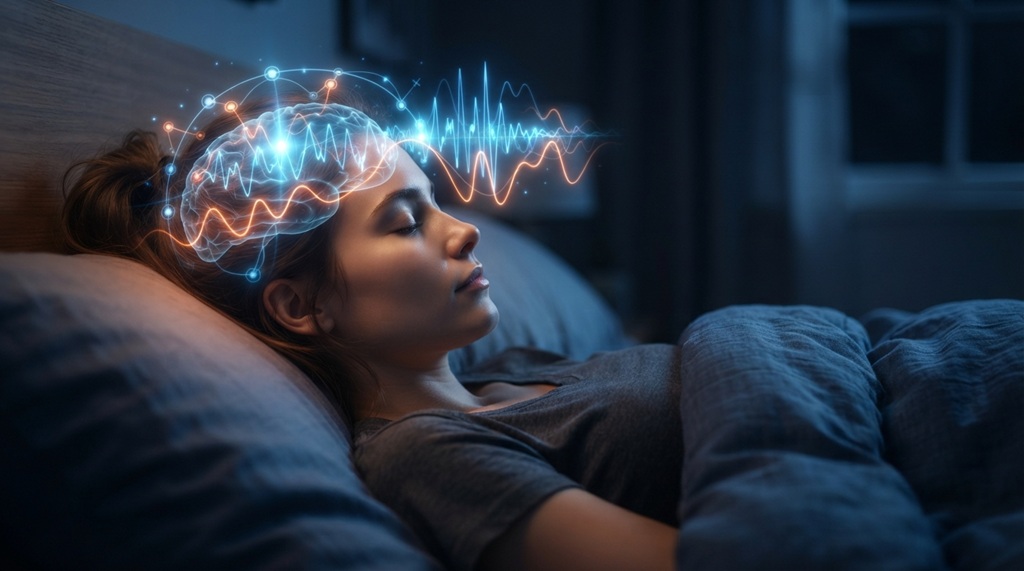
Sleep moves through four distinct stages that repeat in cycles all night long. Each stage plays a different role in your brain’s health. Deep sleep clears waste from your brain and restores your body. REM sleep processes emotions and locks in memories. Skipping either stage, even for a few nights, hurts how you think and feel the next day.
Most people know sleep matters. Fewer people know why the type of sleep matters just as much as the amount. Your brain doesn’t just power down at night it cycles through active, specific phases of repair and processing.
This guide breaks down each sleep stage in plain language. You’ll learn what happens in your brain during each phase, why REM and deep sleep deserve special attention, and how to protect both.
What Are the Four Stages of Sleep?
Sleep has four stages: three non-REM stages and one REM stage. Your brain cycles through all four roughly every 90 minutes, repeating this pattern four to six times per night.
The stages break down like this:
- Stage 1 (N1): Light sleep. You drift in and out and can wake easily.
- Stage 2 (N2): Your heart rate slows and body temperature drops. You spend the most total time here.
- Stage 3 (N3): Deep sleep. Your body repairs tissue and strengthens your immune system.
- REM sleep: Your brain becomes highly active. Most dreaming happens here.
Early sleep cycles contain more deep sleep. Later cycles, closer to morning, contain more REM sleep. This is one reason cutting your sleep short even by an hour disproportionately steals REM time, since it’s weighted toward the back half of the night.
Stage 1: The Light Sleep Transition
Stage 1 sleep is the brief bridge between being awake and being asleep. It typically lasts just one to seven minutes.
During this stage, your muscles start to relax, and your brain waves slow down from their daytime pattern. You might experience a sudden muscle twitch, known as a hypnic jerk, or feel like you’re falling. Both are normal.
This stage is easy to interrupt. A noise, a light, or a partner shifting in bed can pull you right back to full wakefulness. Because Stage 1 is so light, it doesn’t offer much restorative value on its own it’s simply the doorway into deeper sleep.
Stage 2: The Foundation of Your Sleep Cycle
Stage 2 makes up close to half of your total sleep time, making it the largest single stage of the night. Your body temperature drops, your heart rate slows, and your brain produces short bursts of activity called sleep spindles.
Researchers believe these sleep spindles play a role in memory consolidation, helping your brain sort and store information gathered during the day. Stage 2 also serves as a stabilizing phase between lighter and deeper sleep, keeping your sleep cycle on track.
While Stage 2 doesn’t get as much attention as deep sleep or REM, losing large amounts of it still affects how rested you feel. It’s the connective tissue that holds your entire sleep architecture together.
Stage 3: Deep Sleep and Why Your Brain Needs It
Deep sleep, also called slow-wave sleep, is when your body does its heaviest physical repair work. It’s also when your brain performs a critical cleaning process that protects long-term brain health.
How Deep Sleep Repairs Your Body
During deep sleep, your body releases growth hormone, which repairs muscle tissue and strengthens your immune system. Your blood pressure drops, and your breathing becomes slow and steady. This is the stage most responsible for that feeling of being physically refreshed after a good night’s sleep.
How Deep Sleep Clears Your Brain
According to sleep researchers, deep sleep activates the brain’s glymphatic system, a waste-clearance process that flushes out metabolic byproducts, including proteins linked to Alzheimer’s disease. Think of it as your brain’s nightly cleaning crew. When deep sleep is cut short repeatedly, this cleanup process falls behind, and waste products can build up over time.
Deep sleep is also notoriously hard to wake up from. If you’ve ever been jolted awake during this stage, you know the groggy, disoriented feeling it’s called sleep inertia, and it can take 15 to 30 minutes to fully wear off.
REM Sleep: The Stage Your Brain Uses to Process Emotions
REM sleep, short for rapid eye movement sleep, is when your brain becomes nearly as active as it is when you’re awake. This is the stage most associated with vivid dreaming.
What Happens in Your Brain During REM
Your eyes move rapidly behind closed lids, your breathing quickens, and your brain activity spikes. Meanwhile, your body enters a temporary state of paralysis called REM atonia, which prevents you from physically acting out your dreams.
Sleep scientists believe REM sleep helps your brain process and regulate emotions. It’s thought to strip the intense emotional charge from difficult memories while preserving the factual details, essentially helping you process the day without the emotional sting.
Why REM Sleep Matters for Memory and Learning
REM sleep supports procedural memory, the kind of memory involved in learning new skills, from playing an instrument to riding a bike. It also plays a role in creative problem-solving, since your brain makes unusual connections between unrelated ideas during this stage.
Most REM sleep happens in the second half of the night. This is why people who consistently sleep less than six hours often report feeling emotionally flat, foggy, or more reactive to stress they’re simply getting less REM sleep than their brain needs.
What Happens When You Don’t Get Enough REM or Deep Sleep

Chronic sleep deprivation extends far beyond daytime fatigue; it systematically starves the brain of crucial REM and deep sleep cycles, triggering compounded neurological damage over time. When deep sleep is compromised, physical recovery stalls, immune defenses weaken, and the brain forfeits its primary window for flushing out toxic waste proteins linked to neurodegenerative decline. Conversely, a deficit in REM sleep severely impairs emotional regulation, destabilizes mood, and hinders cognitive adaptability by disrupting memory consolidation. Crucially, the timing of sleep loss dictates its functional impact: because deep sleep dominates the first third of the night while REM sleep concentrates heavily in the hours before waking, staying up late disproportionately strips your brain of emotional and cognitive processing, whereas an abrupt early wake-up primarily cuts physical restoration short. For those unable to secure full overnight sleep cycles, integrating daytime recovery protocols becomes essential if you frequently struggle with midday mental exhaustion, learning do non-sleep deep rest for brain fog offers an evidence-based mechanism to restore executive function without disrupting your natural circadian rhythm.
How to Protect Your Deep Sleep and REM Sleep
You can support both deep sleep and REM sleep through a few consistent habits, most of which come down to protecting your sleep schedule and your sleep environment.
- Keep a consistent sleep and wake time, even on weekends. This helps stabilize your natural sleep cycles.
- Avoid alcohol close to bedtime. It can help you fall asleep faster but suppresses REM sleep later in the night.
- Keep your bedroom cool and dark. Deep sleep is sensitive to temperature and light disruption.
- Limit screens for an hour before bed. Blue light can delay the release of melatonin, pushing your whole sleep cycle later.
- Get sunlight exposure early in the day. This helps anchor your circadian rhythm, which governs when deep sleep and REM sleep occur.
- Avoid cutting sleep short on either end. Since deep sleep clusters early and REM clusters late, shortening sleep from either direction steals a different, specific benefit.
Frequently Asked Questions
How much deep sleep and REM sleep do I need each night?
Most healthy adults get roughly 13-23% of total sleep in deep sleep and around 20-25% in REM sleep, though this varies by age and individual. For a typical 7-8 hour night, that translates to roughly one to two hours of each stage.
What stage of sleep is most important?
Both deep sleep and REM sleep are essential, but they serve different purposes: deep sleep restores your body and clears brain waste, while REM sleep processes emotions and consolidates memory. Neither stage can fully substitute for the other.
Can you increase your deep sleep naturally?
Yes, regular exercise, a consistent sleep schedule, and avoiding alcohol before bed can all increase the amount of deep sleep you get. Keeping your bedroom cool also supports deeper, more uninterrupted sleep.
Why do I remember dreams from REM sleep but not other stages?
Dreams can occur in any sleep stage, but REM dreams tend to be more vivid, emotional, and story-like, making them easier to recall. You’re also more likely to wake directly out of REM sleep, which improves dream recall since memory consolidation hasn’t yet taken place.
Does age affect how much deep sleep or REM sleep you get?
Yes, both deep sleep and REM sleep naturally decline with age. Older adults often experience lighter, more fragmented sleep, which is one reason sleep quality tends to become a bigger focus later in life.
Conclusion
Sleep isn’t one uniform state it’s a structured cycle of four stages, each with a distinct job. Deep sleep restores your body and clears waste from your brain. REM sleep processes emotions and strengthens memory. Both matter, and both are easy to lose without realizing it.
Protecting your sleep schedule, limiting alcohol, and keeping a consistent bedtime are simple, evidence-backed ways to give your brain the deep sleep and REM sleep it needs every night.